
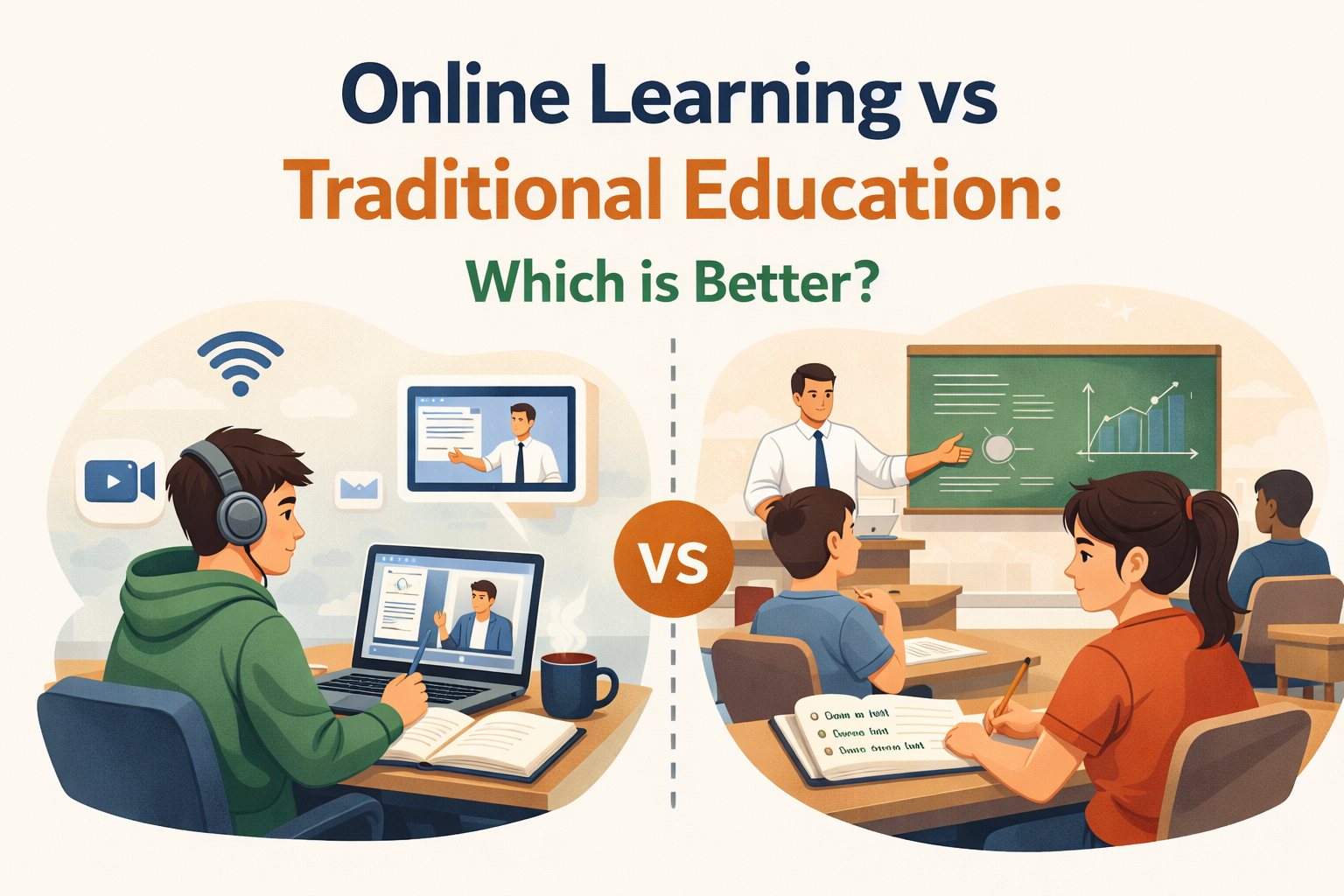
Ask this question in a room full of students, and you’ll notice something right away—people don’t just answer it, they take sides.
Some will say classrooms are still the best way to learn. Others will tell you everything you need is already online. Both opinions make sense in their own way, which is why this debate never really ends.
If you look at it carefully, learning itself hasn’t changed much. People still learn by understanding, practicing, and repeating. What’s changed is how easily we can access information.
That shift is what’s made online learning so popular—and at the same time, it’s why traditional education still holds its place.
This guide from learnvistaonline isn’t about proving one is better. It’s about helping you think clearly and choose what actually fits your situation.
Online Learning: Freedom That Sounds Easy (But Isn’t Always)
At first glance, online learning feels simple.
You open your phone or laptop, pick a topic, and start learning. No travel. No fixed time. No pressure from a classroom.
Sounds perfect, right?
In many ways, it is. You can pause, rewind, skip ahead, or repeat things as many times as you want. That kind of control is something traditional systems can’t really offer.
But here’s the part people don’t talk about enough—too much freedom can slow you down.
Without deadlines or structure, it’s very easy to delay things. You tell yourself you’ll do it later. Then later becomes tomorrow. Then next week.
That’s how many free online courses get left unfinished.
Traditional Education: Structured, but Sometimes Rigid
Now compare that with traditional education.
You have a schedule. You have classes. You have exams whether you’re ready or not.
It doesn’t always feel comfortable, but it keeps you moving.
You also get something that’s harder to replace online—real-time interaction. You can ask questions instantly, discuss ideas, and learn alongside other students.
That environment matters more than people think.
At the same time, it’s not perfect either. Sometimes the pace feels too slow. Sometimes too fast. And sometimes, you’re learning things you’re not even sure you’ll use.
Where Online Learning Actually Wins
There are a few areas where online learning clearly stands out.
First, flexibility.
You’re not tied to a location or timing. You can learn late at night, early in the morning, or whenever you feel focused.
Second, accessibility.
A lot of online learning platforms make it possible to learn without spending much. In some cases, without spending anything at all.
Third, skill-based focus.
Many courses focus directly on practical skills—things you can actually use. That’s why online skills learning is often connected with online earning.
Where Traditional Education Still Makes Sense
Even with all the growth in online learning, traditional education isn’t going anywhere.
In fact, in some areas, it’s still necessary.
Fields like medicine, engineering, and law require structured education. You can’t replace that with random courses.
Also, not everyone learns well alone.
Some students need a system around them—a schedule, teachers, classmates. Without that, they struggle to stay consistent.
And consistency matters more than the method.
The Real Problem Isn’t the Method
Here’s something most people miss.
The problem usually isn’t whether you choose online or traditional learning.
The problem is inconsistency.
You start something, then stop. You switch to something else. Then repeat the cycle.
It happens in both systems.
You can sit in a classroom and still not learn. You can take online courses and still not improve.
So the focus shouldn’t just be on the method—it should be on how you use it.
A More Practical Way to Think About It
Instead of choosing one and ignoring the other, a better approach is to combine both.
For example:
You follow traditional education for your main studies. At the same time, you use online resources to build extra skills.
This is where things start to make sense.
You get structure from one side and flexibility from the other.
A lot of students are already doing this without even realizing it.
What About Career Growth?
This is where things are changing quickly.
Today, skills matter more than ever. Not just degrees.
That’s why high income skills and practical abilities are getting so much attention.
Online learning makes it easier to build those skills and start applying them—sometimes even while you’re still studying.
But again, it depends on how seriously you take it.
So… Which One Is Better?
Honestly, there isn’t a clean answer.
If you’re self-disciplined, focused, and clear about what you want, online learning can take you very far.
If you prefer guidance, structure, and a fixed path, traditional education might suit you better.
Most people fall somewhere in the middle.
Final Thoughts
This isn’t really a competition.
Both systems have strengths. Both have weaknesses.
The difference comes down to how you use them.
If you stay consistent, either path can work. If you don’t, neither will.
And if you’re trying to keep things simple and avoid confusion, learnvistaonline focuses exactly on that—practical learning without overcomplicating things.
You don’t need the perfect choice.
You just need to keep going.