
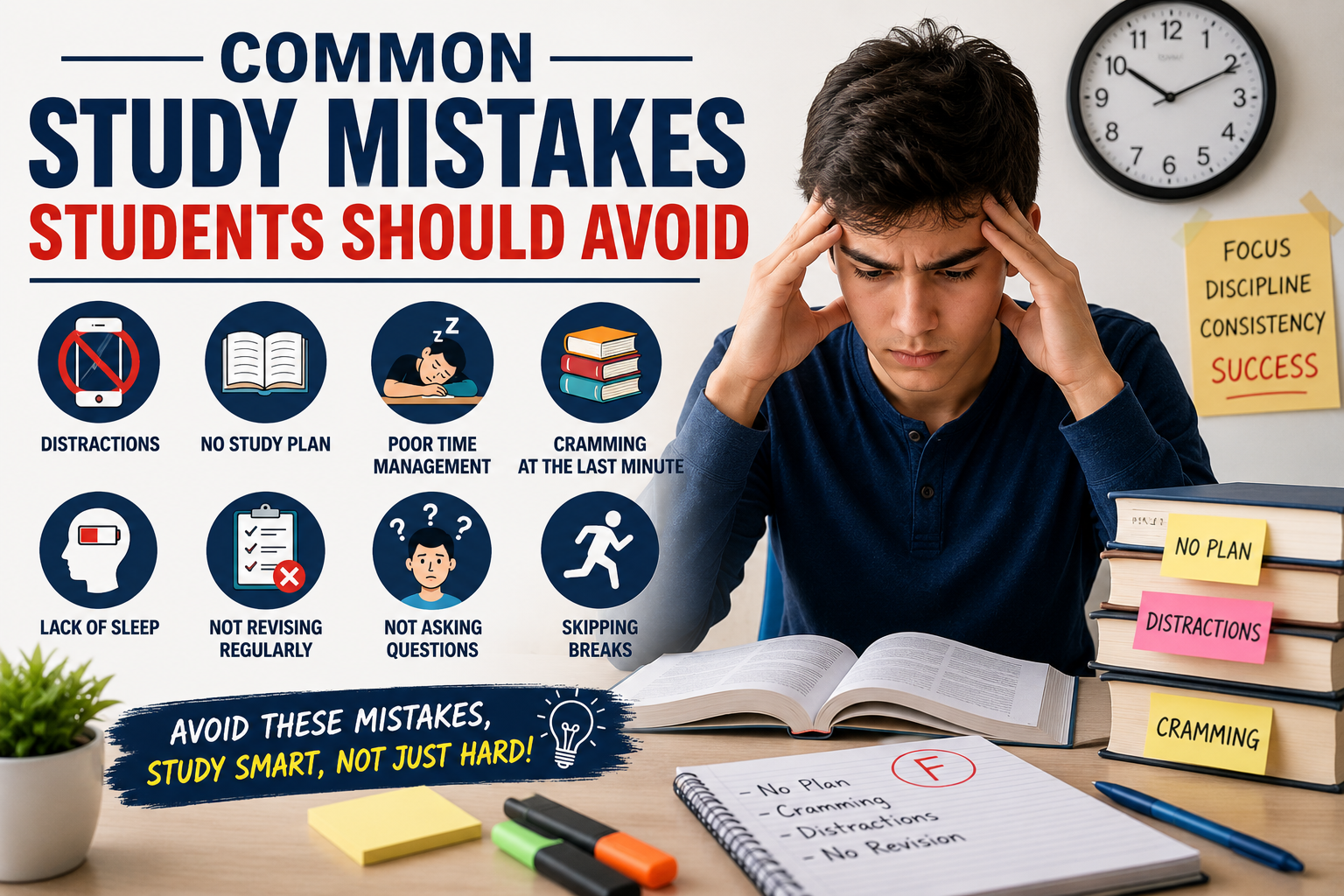
Introduction
Every student wants better grades, improved learning, and academic success. However, many students unknowingly make mistakes that slow down their progress and reduce their ability to learn effectively. The truth is that success in academics is not only about studying harder; it is also about avoiding the habits and behaviors that negatively impact learning.
Many students spend hours with their books open but still struggle to achieve the results they want. This often happens because they follow ineffective study methods, poor routines, or unhealthy habits. Understanding these common mistakes can help students improve their performance, save time, and reduce stress.
In this guide, we will explore the most common study mistakes students should avoid, along with practical solutions to become a more effective learner.
Why Avoiding Study Mistakes Matters
Learning is not just about the amount of time spent studying. It is also about the quality of your study sessions. When students eliminate bad habits and adopt better strategies, they can:
- Improve academic performance
- Increase productivity
- Retain information longer
- Reduce exam stress
- Develop effective study habits
- Improve student productivity
- Achieve better grades with less effort
Avoiding common mistakes is often the fastest way to improve learning outcomes.
Mistake #1: Studying Without a Plan
One of the biggest mistakes students make is sitting down to study without a clear objective.
Without a plan, students often waste time deciding what to study, switching between subjects, or getting distracted.
Solution
Create a study schedule before each study session.
Your study plan should include:
- Subjects to cover
- Chapters to complete
- Practice questions
- Revision time
A structured study routine for students helps maintain focus and consistency.
Mistake #2: Cramming Before Exams
Many students wait until the last few days before exams to begin serious studying.
This habit creates stress, anxiety, and information overload.
While cramming may help you remember some facts temporarily, it rarely leads to long-term understanding.
Solution
Use consistent daily study sessions.
Following exam preparation tips throughout the semester is far more effective than last-minute cramming.
Mistake #3: Multitasking While Studying
Students often believe they can study while texting friends, watching videos, or checking social media.
Unfortunately, multitasking reduces concentration and learning efficiency.
Solution
Focus on one task at a time.
Learning how to avoid distractions while studying can dramatically improve your concentration and retention.
Put your phone away and create a distraction-free environment.
Mistake #4: Passive Reading
Simply reading textbooks repeatedly is not always an effective way to learn.
Many students spend hours reading but struggle to remember what they studied.
Solution
Use active learning techniques such as:
- Taking notes
- Summarizing information
- Teaching concepts to others
- Solving practice questions
Active learning improves understanding and memory retention.
Mistake #5: Ignoring Weak Subjects
Many students prefer studying subjects they already enjoy and understand.
As a result, they avoid challenging subjects until exams are near.
Solution
Identify weak areas early.
Spend extra time improving difficult topics instead of avoiding them.
This approach strengthens overall academic performance.
Mistake #6: Poor Time Management
One of the most common study mistakes students should avoid is poor time management.
Students often underestimate how long tasks will take or spend too much time on less important activities.
Solution
Practice time management for students by:
- Setting priorities
- Creating deadlines
- Breaking large tasks into smaller goals
- Using productivity tools
Good time management reduces stress and increases efficiency.
Mistake #7: Not Taking Breaks
Studying for several hours without rest can lead to mental fatigue.
A tired brain struggles to absorb and process information.
Solution
Use the Pomodoro Technique:
- Study for 25 minutes
- Take a 5-minute break
- Repeat
Regular breaks improve focus and support better concentration while studying.
Mistake #8: Lack of Sleep
Many students sacrifice sleep to study longer.
However, sleep deprivation negatively affects memory, concentration, and problem-solving skills.
Solution
Aim for 7–9 hours of quality sleep each night.
Proper sleep improves:
- Memory retention
- Learning speed
- Focus
- Academic performance
Good sleep is one of the most underrated study tips for students.
Mistake #9: Skipping Revision
Students often learn new material but fail to review it regularly.
Without revision, information gradually fades from memory.
Solution
Schedule weekly revision sessions.
Regular review helps strengthen long-term memory and improves exam performance.
Mistake #10: Studying in a Distracting Environment
Noise, clutter, television, and social media notifications can significantly reduce focus.
Solution
Create a dedicated study area that is:
- Quiet
- Organized
- Comfortable
- Free from distractions
A productive environment supports how to focus on studies more effectively.
Mistake #11: Relying Only on Memorization
Memorization has its place, but understanding concepts is more important.
Students who only memorize often struggle when questions are presented differently.
Solution
Focus on understanding concepts rather than simply memorizing facts.
Ask yourself:
- Why does this work?
- How can I apply this concept?
- Can I explain it to someone else?
Deep understanding leads to stronger learning outcomes.
Mistake #12: Comparing Yourself to Other Students
Many students become discouraged when they compare their grades, study speed, or achievements with others.
Comparison can reduce motivation and create unnecessary stress.
Solution
Focus on your personal progress.
Everyone learns at a different pace.
Consistent improvement matters more than competing with others.
Mistake #13: Not Setting Academic Goals
Students who lack clear goals often lose motivation.
Without direction, studying can feel pointless and overwhelming.
Solution
Set SMART goals:
- Specific
- Measurable
- Achievable
- Relevant
- Time-bound
Goal setting increases study motivation and helps maintain focus.
Mistake #14: Ignoring Physical Health
Academic success is closely connected to physical well-being.
Poor diet, lack of exercise, and dehydration can negatively affect brain performance.
Solution
Maintain healthy habits:
- Eat nutritious foods
- Stay hydrated
- Exercise regularly
- Get enough sleep
Healthy students often experience higher student productivity and better concentration.
Mistake #15: Giving Up Too Quickly
Many students become frustrated when they do not understand a topic immediately.
Learning takes time and patience.
Solution
Develop a growth mindset.
Instead of saying:
“I can’t do this.”
Say:
“I can’t do this yet.”
Persistence is often the difference between average and exceptional performance.
Best Study Habits for Academic Success
To avoid these common mistakes, focus on building strong effective study habits:
- Follow a consistent study schedule
- Review material regularly
- Practice active learning
- Eliminate distractions
- Prioritize sleep
- Manage your time wisely
- Stay physically active
- Set realistic goals
These habits can dramatically improve learning efficiency and academic results.
Conclusion
Every student makes mistakes, but successful students learn from them and continuously improve their study habits. Avoiding common errors such as cramming, multitasking, poor time management, lack of sleep, and passive learning can significantly improve academic performance.
By developing effective study habits, improving time management for students, and learning how to focus on studies, students can achieve better results while reducing stress and increasing confidence.
Remember that academic success is not about perfection. It is about making small improvements every day and consistently moving toward your goals.
Frequently Asked Questions (FAQs)
What is the biggest study mistake students make?
One of the biggest mistakes is studying without a plan. A structured study schedule helps students stay organized and productive.
Why is cramming bad for students?
Cramming increases stress and often leads to short-term memorization rather than long-term understanding.
How can students improve concentration while studying?
Students can improve focus by eliminating distractions, getting enough sleep, taking regular breaks, and practicing active learning techniques.
What are effective study habits?
Some of the best effective study habits include creating a study plan, reviewing material regularly, setting goals, and maintaining a healthy lifestyle.
How important is time management for students?
Time management for students is essential because it helps balance studies, assignments, exams, and personal responsibilities efficiently.